top of page


AI-CVD Summary
Coronary Calcification

_4_edited.jpg)
Aortic Calcification

Epicardial Fat
_5_edited.jpg)
Cardiac Chambers
_7_edited.jpg)
Aorta & PA Size
_10_edited.jpg)
Lung LAI
_9_edited.jpg)
Lung HAI
_11_edited.jpg)
Liver Fat
_12_edited.jpg)
Muscle & Visceral Fat
_13_edited.jpg)
Bone Density

AI-CVD Bundle


%20.png)




![Pattern 5 [Converted]-01.png](https://static.wixstatic.com/media/51c62d_44f38c257d614130ace0f56455e9be12~mv2.png/v1/fill/w_980,h_718,al_c,q_90,usm_0.66_1.00_0.01,enc_avif,quality_auto/51c62d_44f38c257d614130ace0f56455e9be12~mv2.png)
Knowledge Center
Search


HeartLung.AI Showcases 10 Scientific Presentations at ESC Congress 2026, Advancing AI-Powered Cardiovascular and Lung Imaging
Company-record scientific program shows how AI can uncover coronary, chamber, valvular, plaque and lung cancer risk insights from routine CT. MUNICH, Germany, September 1, 2026- HeartLung.AI today announced the successful completion of a company-record scientific program at ESC Congress 2026 in Munich, where its investigators and academic collaborators presented 10 studies advancing artificial intelligence for cardiovascular prevention, coronary calcium assessment, cardiac ch
Sep 19 min read


What cardiac insights are hiding in millions of routine chest CTs?
ESC 2026 · 10 Scientific Presentations · Oral & Poster · 6/10 CT vs. Echo: Unlocking More From Existing Imaging Approximately 19 million non-gated chest (lung) CT scans are performed in the U.S. each year for a wide range of clinical indications. These scans are not primarily acquired to evaluate cardiovascular disease - but could AI unlock cardiovascular information already captured within them? At ESC Congress 2026, HeartLung.AI presented a study comparing AI-derived ca
Aug 241 min read


What if a routine coronary artery calcium scan could see aortic stenosis risk before symptoms?
ESC 2026 · 10 Scientific Presentations · Oral & Poster · 7/10 One CT. 25 automated phenotypes. Nearly two decades of follow-up. Aortic stenosis is often recognized only after obstruction or myocardial damage has already developed. But could information already captured in a routine noncontrast cardiac CT help identify risk much earlier?' In a new HeartLung.AI scientific poster at ESC Congress 2026, researchers explored whether AI-CVD-derived imaging phenotypes could predi
Aug 241 min read


20 Million Chest CTs. Why Aren’t We Using All the Information They Contain?
ESC Congress 2026 · Scientific Poster Nearly 20 million chest CT scans are performed each year in the U.S.—yet fewer than 5% are ECG-gated. What if AI could extract meaningful cardiac information from the routine non-gated chest CTs already being performed every day? In a new HeartLung.AI scientific poster at ESC Congress 2026, researchers evaluated AI-based cardiac chamber volumetry from non-gated chest CT and compared its ability to predict heart failure (HF) and atrial fib
Aug 241 min read


What if low CAC doesn’t always mean low coronary risk?
ESC 2026 · 10 Scientific Presentations · Oral & Poster · 9/10 Low CAC. Higher EAT. More non-calcified plaque. A low coronary artery calcium (CAC) score can be reassuring - but it may not tell the whole story. Some individuals with low or even zero CAC may still carry non-calcified coronary plaque. Could another biomarker already visible on the same scan help identify them? In a new HeartLung.AI scientific poster at ESC Congress 2026, researchers investigated whether autom
Aug 241 min read


Agatston-2.0: AI-Derived Calcium Burden and Plaque Density Profiling Improve CHD Risk Stratification Within CAC Scores 1–99
Can AI turn the CAC 1–99 “gray zone” into actionable cardiovascular risk? A new HeartLung.AI study, to be presented at ESC Congress 2026 in Munich, explores how Agatston-2.0 can improve coronary heart disease (CHD) risk stratification among individuals with conventional CAC scores of 1–99. The study analyzed 1,542 participants from MESA and the Framingham Heart Study, with a median follow-up of 12.5 years and 151 CHD events. Using measurements derived from a single CAC scan,
Aug 241 min read


What if a routine CAC scan could reveal more than calcium?
ESC 2026 · 10 Scientific Presentations · Oral & Poster · 1/10 Going Beyond the Conventional Agatston Score with Agatston-2.0 Organised by: European Society of Cardiology (ESC) visual A HeartLung.AI study within the Miami Heart Study explores how AI-driven Agatston-2.0 and cardiometabolic phenotyping can uncover signals associated with obstructive stenosis, high-risk plaque, and non-calcified plaque—all from a routine CAC scan. Traditional CAC scoring is highly valuable for
Aug 172 min read


What if a CAC score of zero isn’t truly zero?
ESC 2026 · 10 Scientific Presentations · Oral & Poster · 4/10 HeartLung's AI-CAC can detect small and semi-calcified plaques invisible to human eyes.Same scan. A more refined “zero.” Organised by: European Society of Cardiology (ESC) visual For decades, a coronary artery calcium (CAC) score of zero has been one of the most reassuring findings in cardiovascular prevention. However, a small portion of individuals with CAC=0 experience an adverse coronary cardiovascular even
Aug 171 min read


Can a heart scan reveal lung cancer risk 15 years ahead?
ESC 2026 · 10 Scientific Presentations · Oral & Poster · 3/10 One cardiac scan. A 15-year signal. Organised by: European Society of Cardiology (ESC) visual A coronary artery calcium (CAC) scan is performed for cardiovascular prevention. But could the same scan also reveal something about a patient’s future lung cancer risk? At ESC Congress 2026, HeartLung.AI presented a 15-year study exploring this question using Sybil AI and routine CAC scans from the Multi-Ethnic Study o
Aug 171 min read


What if a routine CAC scan could reveal future AF and stroke risk?
ESC 2026 · 10 Scientific Presentations · Oral & Poster · 2/10 One Scan. More Answers. Organised by: European Society of Cardiology (ESC) visual CMillions of coronary artery calcium (CAC) scans are performed every year—yet much of the information already contained in those images may go unused. At ESC Congress 2026, HeartLung.AI presented new findings showing how AI-derived cardiac chamber metrics from routine, non-contrast CAC scans can help predict long-term atrial fibrill
Aug 171 min read


Performance of Sybil AI for lung cancer risk assessment: a head-to-head comparison of cardiac vs. lung CT scans
ESC Congress 2026 - 28 - 31 Aug 2026 Munich, Germany Organised by: European Society of Cardiology (ESC) visual Can AI assess lung cancer risk from a cardiac CT—even when the entire lung isn’t visible? In this study, Sybil AI was evaluated head-to-head on cardiac coronary artery calcium (CAC) scans and full chest CT scans across 4,486 scans from the FHS and MESA cohorts. Despite the limited lung field of view, Sybil maintained strong lung cancer risk prediction on cardiac CT,
Aug 171 min read


RSNA Features HeartLung.AI Study Linking AI-Quantified Myosteatosis to Future COPD Risk
20-year MESA analysis finds CT-derived muscle quality predicts COPD more strongly than emphysema-like lung measures. HOUSTON, Texas - August 7, 2026 - HeartLung.AI today announced that the Radiological Society of North America (RSNA) has featured a major research publication demonstrating the potential of artificial intelligence-derived myosteatosis measurements from coronary artery calcium (CAC) CT scans to predict future chronic obstructive pulmonary disease (COPD). The ded
Aug 74 min read


Low-Dose Imaging for Early Multi-disease Assessment & Prevention
Low-Dose Imaging for Early Multi-disease Assessment & Prevention is a nonprofit initiative established to advance one of the most ambitious preventive medicine programs ever proposed: the LDCT Mega Trial. The initiative envisions using a single low-dose, non-contrast CT scan combined with artificial intelligence to detect multiple life-threatening diseases before symptoms develop, fundamentally transforming the way preventive healthcare is delivered. The proposed LDCT Mega Tr
Aug 71 min read


Should We Screen Asymptomatic Patients with Coronary CT?
Coronary CT has become one of the most powerful imaging technologies for cardiovascular risk assessment. However, an important clinical question remains: Should Coronary CT Angiography (CCTA) be used routinely to screen asymptomatic individuals, or does Coronary Artery Calcium (CAC) scanning already provide sufficient information for preventive care? This presentation reviews the current evidence comparing CAC scoring and CCTA in primary prevention, examining their predictive
Jul 191 min read


Two HeartLung.AI Studies Show Routine Chest CT Can Assess Cardiac Risk Comparably to Dedicated Cardiac CT and Echocardiography
Complementary MESA analyses validate AI-derived cardiac chamber volumetry from non-gated, non-contrast CT for opportunistic heart failure and atrial fibrillation risk assessment HOUSTON - July 16, 2026 - HeartLung.AI announced the acceptance of two complementary studies in the American Journal of Preventive Cardiology demonstrating that artificial intelligence can extract clinically meaningful cardiac chamber measurements from routine non-gated, non-contrast chest CT and asse
Jul 164 min read


Vision 2030: Preventive Imaging Agentic AI
Thursday, July 9, 2026 | 2:00-3:00 PM PST LDCT Mega Trial Vision 2030 presents HeartLung.AI’s long-term vision for transforming medical imaging into a comprehensive, AI-powered preventive healthcare ecosystem. Rather than generating a diagnostic report alone, the platform is designed to convert a single medical image into a personalized prevention strategy that follows patients throughout their lives. The proposed Preventive Imaging Agentic AI framework integrates multiple in
Jul 151 min read


LDCT Mega Trial - Preventive Imaging Agentic AI vs. Usual Care
Thursday, July 9, 2026 | 2:00-3:00 PM PST | LDCT Mega Trial - Preventive Imaging Agentic AI vs. Usual Care | LIFEMAP Research Group The LDCT Mega Trial is an ambitious vision for one of the largest prospective clinical studies ever proposed in artificial intelligence, designed to evaluate whether an Agentic AI-powered preventive imaging ecosystem can improve long-term health outcomes compared with conventional medical care. The proposed randomized trial plans to enroll 100,00
Jul 151 min read


AI-CVD: AI-Powered Cardiovascular Risk Assessment from CAC and Chest CT
Thursday, July 9, 2026 | 2:00-3:00 PM PST LDCT Mega Trial - Preventive Imaging Agentic AI vs Usual CareLIFEMAP Research Group AI-CVD is an advanced artificial intelligence platform that transforms routine coronary artery calcium (CAC) and chest CT scans into comprehensive cardiovascular risk assessments by extracting a wide range of imaging biomarkers from a single examination. Rather than relying solely on traditional clinical risk factors, AI-CVD analyzes multiple cardiome
Jul 151 min read


AI-CAC: Coronary Plaque Analysis from Non-Contrast CT
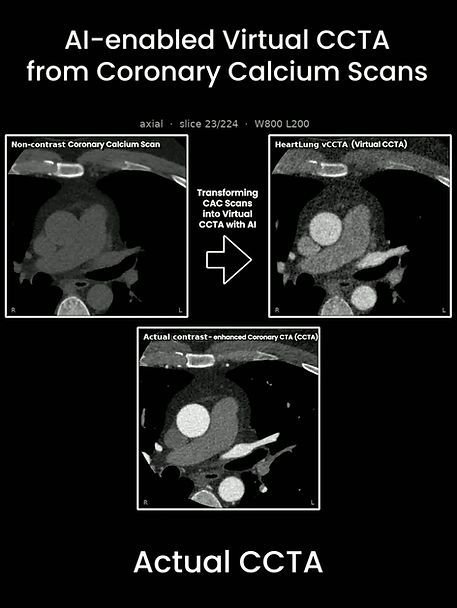
AI-CAC introduces a novel artificial intelligence approach for coronary plaque analysis using non-contrast cardiac CT (CAC) scans, offering the potential to extract plaque characteristics traditionally obtainable only from contrast-enhanced coronary CT angiography (CCTA). Conventional CCTA provides excellent visualization of coronary anatomy but requires intravenous contrast administration and is affected by scanner-, software-, and observer-related variability. AI-CAC addres
Jul 151 min read


Agatston-2.0: A New Generation of AI-Based Coronary Calcium Analysis
Agatston-2.0 is a next-generation artificial intelligence framework developed to enhance cardiovascular risk assessment in individuals with Agatston coronary artery calcium (CAC) scores below 100—a population that represents nearly 75% of individuals undergoing CAC scanning and accounts for a substantial proportion of future coronary heart disease events. Rather than relying solely on conventional calcium scoring, Agatston-2.0 introduces advanced AI-derived biomarkers that an
Jul 151 min read
Ready to Unlock the Value in Your CT Scans?
Join leading healthcare providers using AI-CVD to save lives and increase revenue, and lead the future of preventive cardiology.

bottom of page