


_4_edited.jpg)

_5_edited.jpg)
_7_edited.jpg)
_10_edited.jpg)
_9_edited.jpg)
_11_edited.jpg)
_12_edited.jpg)
_13_edited.jpg)


%20.png)




What if a routine CAC scan could reveal future AF and stroke risk?
Updated: Aug 26
ESC 2026 · 10 Scientific Presentations · Oral & Poster · 2/10
One Scan. More Answers.
Organised by: European Society of Cardiology (ESC) visual

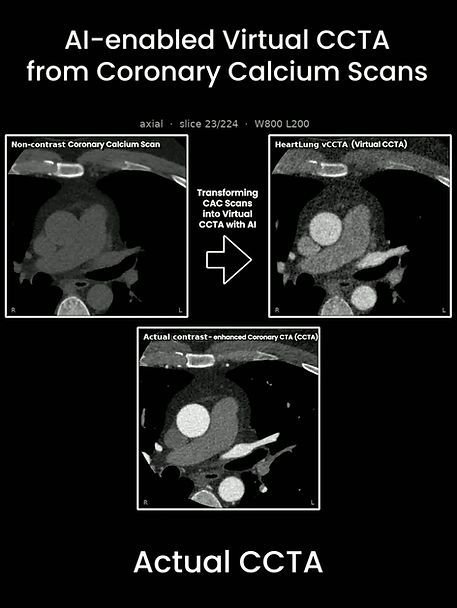
CMillions of coronary artery calcium (CAC) scans are performed every year—yet much of the information already contained in those images may go unused.
At ESC Congress 2026, HeartLung.AI presented new findings showing how AI-derived cardiac chamber metrics from routine, non-contrast CAC scans can help predict long-term atrial fibrillation (AF) and stroke risk.
Using HeartLung.AI’s AutoChamber AI, researchers automatically derived left atrial volume index (LAVI), LA/RA ratio, and LA/LV ratio from existing CAC scans.
Across 6,812 participants from MESA and the Framingham Heart Study, followed for a median of 17 years:
1,302 participants developed atrial fibrillation
365 experienced stroke
Participants above the 95th percentile of LAVI had a 2.67× higher adjusted risk of AF
Elevated LA metrics provided additional risk stratification beyond established clinical risk scores

The findings demonstrate the potential of AI to extract clinically meaningful cardiovascular information from CT scans originally acquired for coronary calcium assessment—expanding the value of an existing scan beyond its original purpose.
One scan. More insight. Greater opportunity for earlier risk assessment.
Download the full presentation below to explore the methodology, results, and clinical implications.


Comments