


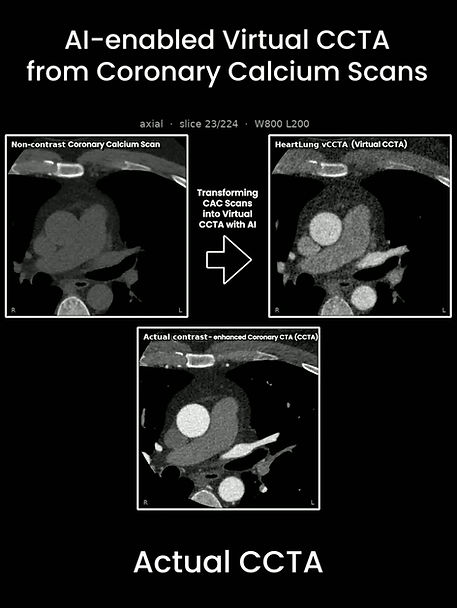


Comparison of AI-Enabled Cardiac Chamber Volumetry Based on Non-Gated Chest CT Scans with Echocardiography
A concise review of the AI-CVD study comparing automated cardiac chamber measurements from routine, non-gated chest CT with echocardiography in the Multi-Ethnic Study of Atherosclerosis (MESA).
Study design
The analysis included 1,675 MESA participants who underwent both non-contrast, non-gated chest CT and echocardiography at Exam 6 (2016–2018). An AI-enabled system (AutoChamber™) measured cardiac chambers on CT. The study evaluated how these measurements identified prevalent and incident heart failure (HF) and atrial fibrillation (AF), with a median follow-up of 2.6 years for HF and 1.6 years for AF.
Main findings
For incident HF, a model combining CT-derived left ventricular volume index (LVVI) with age and sex had a C-index of 0.82, compared with 0.79 for the corresponding echocardiography model; the difference was not statistically significant (p=0.36). For incident AF, models using CT-derived left atrial volume index (LAVI) and echocardiography-derived LAVI both had a C-index of 0.73 (p=0.66). The findings therefore suggest comparable discrimination between modalities in this cohort.
CT-derived chamber volume indices were higher on average than echocardiography-derived values. The authors discuss known modality-related differences and emphasize that CT-based AI assessment is intended as opportunistic screening and triage when CT has already been obtained, not as a replacement for echocardiography.
Interpretation and limitations
These results support the potential use of AI to extract cardiovascular information from routine chest CT without contrast or ECG gating. The analysis was based on a single MESA examination and had relatively short follow-up with 16 incident HF events and 49 incident AF events. Larger studies, longer follow-up, broader age ranges, and clinical and cost-effectiveness evaluations are needed before wider clinical conclusions can be drawn.
Article details
Seyed Reza Mirjalili et al. American Journal of Preventive Cardiology, Volume 31 (2027), article 101731. Published online July 9, 2026. DOI: 10.1016/j.ajpc.2026.101731.


Comments