






HeartLung.AI to Present Nine Abstracts at RSNA 2026
PRESS RELEASE | RSNA 2026
Research spans coronary plaque and calcium scoring, heart failure imaging, cardiovascular risk from chest X-rays, and lung cancer risk from CT.

Chicago, Illinois - HeartLung Corporation (HeartLung.AI) will present nine accepted scientific abstracts at the Radiological Society of North America’s 2026 Annual Meeting, November 29–December 3 at McCormick Place in Chicago.
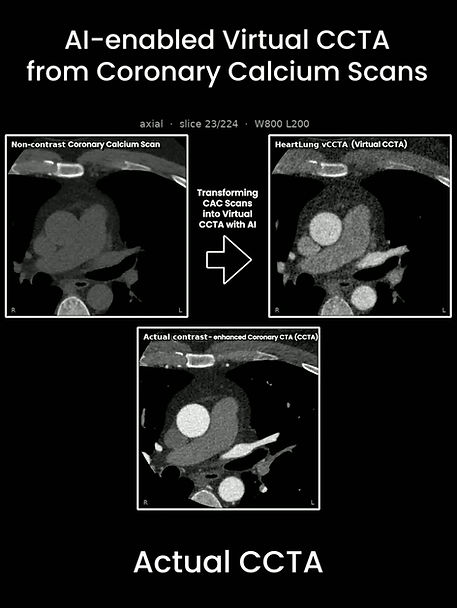
The research examines how AI can use information already present on routine medical images to support risk assessment. The studies evaluate coronary calcium and plaque, cardiac chamber measurements, cardiovascular risk from chest radiographs, and lung cancer risk from coronary calcium and low-dose chest CT scans.
Nine accepted abstracts
Times below are session start times in Chicago (CST). Follow each link for the official presentation record.
1. Agatston-2.0: AI-Derived Coronary Artery Calcium Burden and Density Profiling Improve Coronary Heart Disease Risk Stratification Within CAC Scores of 1–99
RSNA program highlight: Amir Azimi
In 1,238 participants with conventional coronary artery calcium (CAC) scores of 1–99, combining AI-derived calcium burden with plaque density identified groups with different long-term rates of coronary heart disease. Participants with higher AI-derived calcium burden and less dense plaque had the highest observed incidence.
2. Imaging-Based Versus Epidemiologic Risk Prediction for 6-Year Lung Cancer on Baseline Low-Dose CT: Sybil AI Compared With PLCOm2012 in U.S. and Spanish Screening Cohorts
RSNA program highlight: Mohammadhossein Mozafarybazargany
The study compared Sybil, which analyzes baseline low-dose CT, with PLCOm2012 for predicting six-year lung cancer risk. Sybil showed significantly better discrimination in the Spanish screening cohort. The difference in the U.S. cohort was not statistically significant, and Sybil classified more people as high risk.
3. Opportunistic Lung Cancer Detection and Risk Stratification from Coronary Artery Calcium CT Using Sybil AI: A 15-Year MESA Cohort Study
RSNA program highlight: Mohammadhossein Mozafarybazargany
Researchers applied Sybil to coronary artery calcium CT scans in MESA. The model discriminated most strongly at one year (AUC 0.83) and retained a risk signal at 15 years (AUC 0.70), supporting further validation of this approach on cardiac CT scans.
4. Opportunistic AI Evaluation of Cardiac Chambers in Non-Contrast CT Differentiates HFpEF and HFrEF Phenotypes
RSNA program highlight: Amir Azimi
Across three cohorts, the study assessed whether cardiac measurements from non-contrast CT could distinguish heart failure with preserved versus reduced ejection fraction. Left ventricular volume index provided the most consistent separation between groups.
5. AI Chest Radiograph Cardiovascular Risk Model (AI-CX-CVD) Adds Prognostic Value Beyond Traditional ASCVD Risk in MIMIC-CXR
RSNA program highlight: Amir Azimi
In MIMIC-CXR, an AI risk score from chest radiographs added prognostic information beyond traditional ASCVD risk assessment, particularly for atrial fibrillation and heart failure. The traditional score performed better for myocardial infarction and ischemic stroke.
6. Agatston-2.0: A Next-Generation AI-Based Coronary Calcium Quantification Approach to Improve Risk Stratification Among Individuals with Zero Agatston Scores: An AI-CVD Study Within the Multi-Ethnic Study of Atherosclerosis and Framingham Heart Study
RSNA program highlight: Amir Azimi
In a pooled MESA and Framingham Heart Study analysis, Agatston-2.0 detected coronary calcium in 21.7% of participants with a conventional CAC score of zero. Twenty-year coronary heart disease incidence was 7.7% with detectable AI-derived calcium and 3.8% without it.
7. Automated Epicardial Adipose Tissue Analysis Identifies Increased Non-Calcified Plaque Burden in Normal Weight Individuals with Low CAC Scores: The Miami Heart Study
RSNA program highlight: Kyle Atlas
The Miami Heart Study analysis compared epicardial fat measured on coronary calcium scans with noncalcified plaque on paired coronary CT angiography. Among participants with low CAC scores, median noncalcified plaque volume was 34.5 mm³ in the highest epicardial fat quartile versus 11.9 mm³ in the lowest.
8. External Validation of an AI Chest Radiograph Cardiovascular Risk Model (AI-CX-CVD) in MIMIC-CXR for Predicting Incident Cardiovascular Events
RSNA program highlight: Hamed Zarei
In MIMIC-CXR patients without baseline cardiovascular disease, the chest radiograph AI model achieved an AUC of 0.751 for incident composite cardiovascular disease and 0.790 for cardiovascular mortality. Higher model scores were associated with several cardiovascular outcomes after adjustment.
9. Agatston-2.0 Coronary Plaque Density Profiling Refines Risk Stratification Across Calcium Burden Strata. An AI-CVD Study Within the Multi-Ethnic Study of Atherosclerosis (MESA)
RSNA program highlight: Amir Azimi
In 1,751 MESA participants with detectable coronary calcium, higher plaque density ratios were associated with lower coronary heart disease risk across calcium burden groups. The findings suggest plaque density adds prognostic information beyond calcium burden alone.
RSNA 2026 in Chicago
Visit HeartLung.AI at Booth 4865 · South Hall, Level 3 · McCormick Place, Chicago
Annual Meeting: November 29–December 3, 2026
Technical Exhibits: November 29–December 2, 2026 · 10 a.m.–5 p.m. CST daily

About HeartLung.AI
HeartLung.AI develops AI tools for preventive imaging. Its research explores how routine scans can provide additional information about cardiovascular disease, lung cancer and other chronic conditions.


Comments