




A Reassuring Risk Assessment. A Different Story Inside the Arteries.
How a coronary calcium scan revealed hidden risk -and why access matters.

Rob was 52. He exercised every day, ate well, and had only borderline cholesterol. His standard cardiovascular risk assessment placed him in a reassuring category.
From his perspective, there was little reason to feel concerned. He preferred to wait before starting a cholesterol-lowering medication, such as a statin.
Then a coronary artery calcium scan revealed something his risk assessment had not made visible.
His coronary calcium score was 220.
In the case shared by Oren Mechanic, MD, MPH, that finding represented an elevated coronary plaque burden for a man Rob’s age. It introduced a different perspective on his cardiovascular health—and a more concrete starting point for a conversation about prevention.
Rob’s story highlights two connected questions: What happens when a reassuring risk estimate does not tell the whole story? And who gets the opportunity to look more closely?
The Patient at a Glance
Detail | Information shared in the case |
Age | 52 years |
Lifestyle | Daily exercise and a healthy diet |
Cholesterol | Borderline |
Standard risk assessment | Described as reassuring |
Initial preference | Preferred to defer cholesterol-lowering medication |
Coronary calcium score | 220 |
Access to testing | Paid out of pocket |
Before the Scan: Every Reason to Feel Reassured
For someone like Rob, healthy habits can create a reasonable sense of confidence.
He was making an effort. He exercised consistently. He paid attention to his diet. His cholesterol was not dramatically elevated, and the risk assessment offered reassurance.
His preference to postpone medication was part of that picture.
This is what makes the case relatable. Conversations about prevention often take place before a person feels unwell, when the potential benefit of acting today can seem distant or abstract.
Rob’s calcium scan brought new information into that conversation.
The Finding That Changed the Picture
A coronary calcium score of 220 added direct imaging evidence of coronary calcification to Rob’s assessment.
The contrast was striking: his lifestyle and standard risk estimate had appeared reassuring, yet the scan revealed a plaque burden that Dr. Mechanic described as clearly elevated for his age.
The case illustrates how imaging can contribute information beyond an initial risk estimate. For Rob, the discussion was no longer based solely on the likelihood of a future problem. There was now a visible finding to consider with his clinician.
The scan did not predict his future with certainty. It gave him and his clinician more information about the present.
That distinction matters. The value of this story lies in the opportunity for a better-informed prevention discussion—not in a reported treatment result or a guaranteed outcome.
From an Abstract Risk to a Personal Conversation
A risk estimate is a number. An imaging finding can make that number feel personal.
Before the scan, Rob preferred to wait before starting a statin. After the scan, his clinician had additional evidence to bring into a discussion about cardiovascular risk and the next steps appropriate for him.
The original account does not report whether Rob started medication, changed his care plan, or experienced a later cardiovascular event. Those outcomes should not be assumed.
What it does document is an important change in understanding: a reassuring initial assessment and a coronary calcium score of 220 presented different views of the same person’s cardiovascular health.
For patients and clinicians, that difference can become the starting point for a more meaningful conversation.
The Other Finding: Access Was Part of the Story
Rob paid for his scan out of pocket.
That detail may seem secondary to the imaging result, but it sits at the heart of the story.
Rob was able to obtain information that could inform his care because he could afford the test. As Dr. Mechanic points out, many patients cannot.
For those patients, the barrier may arise before a clinician has the chance to discuss an imaging finding. The opportunity to identify risk can depend on whether the test is financially accessible.
A person’s ability to pay should not determine whether they have the opportunity to understand their cardiovascular risk.
That is the broader concern raised by Rob’s case: the potential value of preventive assessment must be considered alongside the practical question of who can access it.
A Call for Medicare Coverage
In their MedPage Today opinion piece, Arthur Agatston, MD, and Oren Mechanic, MD, MPH, argue for a Medicare national coverage determination for coronary artery calcium scoring.
Their article, titled “Medicare Will Pay $50k for Your Heart Attack. It Should Pay $100 to Prevent It,” frames the issue around the balance between paying for acute cardiovascular care and supporting opportunities for earlier risk assessment.
In his accompanying LinkedIn post, Dr. Mechanic describes a clinical case for testing in certain populations and identifies reimbursement as a remaining obstacle.
Rob’s experience gives that policy discussion a human dimension.
Behind the coverage question is a patient who feels well, follows healthy habits, and has little reason to suspect that a closer look could reveal something important.
Looking Ahead: Prevention, Opportunistic Detection, and AI
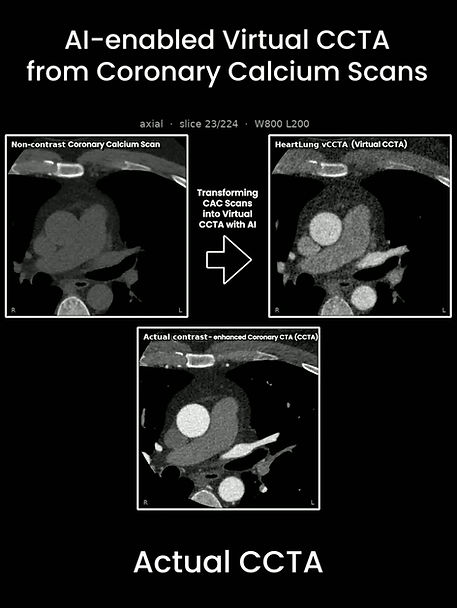
Dr. Mechanic’s post also looks beyond the calcium score itself, highlighting opportunities involving prevention, opportunistic detection, and AI-enabled assessment.
These themes connect closely with HeartLung’s focus on helping clinicians uncover meaningful health insights from CT imaging.
Rob’s case centers on coronary calcium scoring. It does not establish that HeartLung technology was used in his assessment. Its relevance to HeartLung is the broader principle it illustrates: information within a scan can contribute to a person’s understanding of their health.
As imaging and AI continue to develop, the conversation must include both the insights that may be available and the pathways that allow patients to benefit from them.
What Rob’s Story Leaves Us With
Rob’s story begins with reassurance and ends with a more informed understanding of risk.
He was active. He ate well. His cholesterol was only borderline. Yet his coronary calcium scan revealed a finding that deserved attention.
The lesson is not that healthy habits lack value, or that every patient needs the same test. It is that an individual’s cardiovascular story can be more complex than an initial assessment suggests.
For Rob, a closer look revealed information he did not previously have.
For the wider healthcare community, his experience raises a lasting question:
How can we make appropriate preventive assessment accessible to more people before a cardiovascular event becomes their first warning?


Comments