


_4_edited.jpg)

_5_edited.jpg)
_7_edited.jpg)
_10_edited.jpg)
_9_edited.jpg)
_11_edited.jpg)
_12_edited.jpg)
_13_edited.jpg)


%20.png)




AutoLung AI: Expanding the Future of Lung Cancer Detection Beyond Traditional Screening
Updated: Jul 17

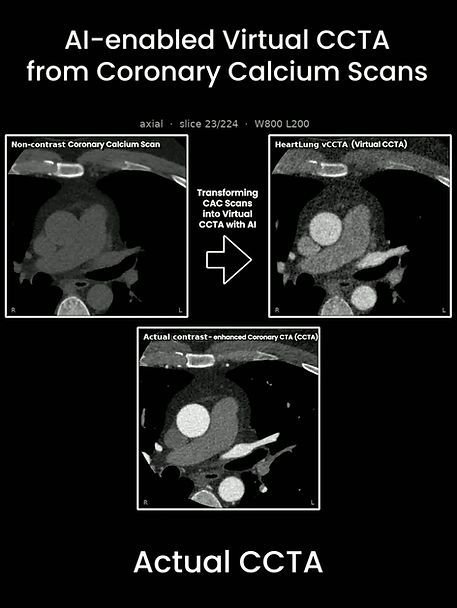
AutoLung AI is an advanced artificial intelligence platform designed to improve lung cancer detection and long-term risk prediction using a wide range of CT imaging studies—not only dedicated low-dose lung cancer screening CT, but also routine chest CT, coronary artery calcium (CAC) scans, and coronary CT angiography (CCTA).
Unlike conventional approaches that primarily focus on pulmonary nodules, AutoLung AI integrates whole-lung imaging biomarkers with nodule-level analysis to provide a more comprehensive assessment of lung cancer likelihood. The platform has demonstrated the ability to identify cancers that may be missed by current Lung-RADS classification, outperform traditional nodule-based assessment, and provide meaningful prediction of future lung cancer risk years before diagnosis.
One of the most significant advantages of AutoLung AI is its ability to transform millions of existing non-screening CT examinations into valuable opportunities for opportunistic lung cancer detection. This includes individuals who fall outside current screening eligibility criteria, such as never-smokers and many former smokers, helping address important gaps in today's screening strategies.
This presentation introduces the clinical rationale, AI architecture, validation studies, and future vision of AutoLung AI, demonstrating how artificial intelligence can support earlier detection, better risk stratification, and ultimately improve patient outcomes.
Download the complete presentation below to explore the full methodology, validation results, and clinical evidence behind AutoLung AI.


Comments