






AHA Stroke Alert Podcast Features HeartLung.AI Research on AI-Predicted Atrial Fibrillation and Stroke
AI-derived left atrial volume and chamber ratios from CAC scans predicted long-term AF and stroke in MESA and Framingham.
HOUSTON, June 18, 2026 - HeartLung.AI today announced that its research article, "AI-Derived LA Volume Index, LA/RA and LA/LV Volume Ratios From Coronary Artery Calcium Scans Predict Long-Term Atrial Fibrillation and Stroke," was featured on the June 2026 episode of the Stroke Alert Podcast, the podcast of Stroke, a journal of the American Heart Association/American Stroke Association.

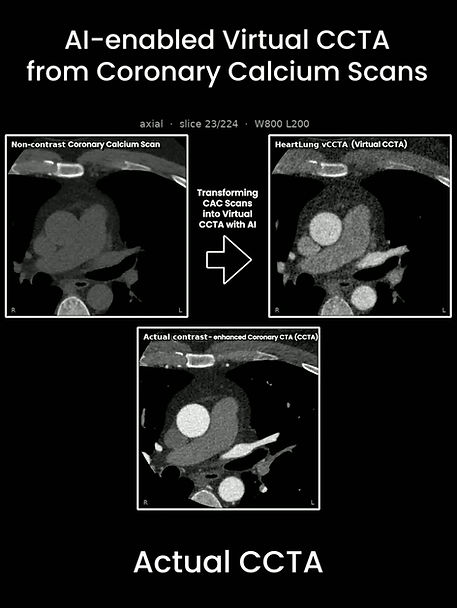
The study demonstrates that artificial intelligence applied to routine, noncontrast coronary artery calcium (CAC) scans can extract cardiac chamber measurements that help predict future atrial fibrillation (AF) and stroke. The findings support a broader role for CAC scans beyond the traditional Agatston calcium score, suggesting that the same low-cost CT examination may provide additional prevention-relevant information without contrast or a separate imaging test.
Using pooled participant-level data from the Multi-Ethnic Study of Atherosclerosis (MESA) and the Framingham Heart Study Offspring cohort, investigators analyzed 6,812 participants and followed them for a median of approximately 17 years. During follow-up, 1,302 participants developed AF and 365 experienced stroke events. Participants in the highest 5 percent of AI-derived chamber metrics had significantly higher long-term risk of both outcomes.
Among the key findings, left atrial volume index was the strongest AI-derived predictor of future AF, while the left atrial-to-right atrial ratio emerged as the strongest AI-derived predictor of stroke. Adding these imaging biomarkers improved risk reclassification beyond established clinical risk models, including CHARGE-AF for atrial fibrillation and the Framingham Stroke Risk Profile for stroke.
"Being featured by the Stroke Alert Podcast is an important recognition of this work and of the broader opportunity to use AI to unlock hidden clinical value from scans already being performed," said Morteza Naghavi, MD, founder of HeartLung.AI and senior author of the study. "A CAC scan should not be viewed only as a calcium score. With AI, it can also reveal cardiac chamber remodeling associated with future atrial fibrillation and stroke - two major causes of morbidity, mortality, and health care cost."
The authors note that the findings are intended to support improved risk prediction and hypothesis generation for future clinical studies. Further research is needed to determine how AI-derived chamber measurements from CAC scans should be incorporated into clinical workflows, preventive care pathways, rhythm monitoring strategies, and stroke prevention programs.
The Stroke Alert Podcast segment summarized the article and its key findings for the stroke and vascular neurology community. The podcast feature highlights the growing interest in AI-enabled opportunistic imaging as a strategy to identify patients at elevated risk before clinical events occur.
Key study facts
Article | AI-Derived LA Volume Index, LA/RA and LA/LV Volume Ratios From Coronary Artery Calcium Scans Predict Long-Term Atrial Fibrillation and Stroke |
Journal | Stroke |
Cohorts | Multi-Ethnic Study of Atherosclerosis and Framingham Heart Study Offspring cohort |
Participants | 6,812 total: 5,670 from MESA and 1,142 from FHS |
Follow-up | Median approximately 17 years |
Outcomes | 1,302 incident atrial fibrillation events and 365 stroke events |
Main finding | AI-derived left atrial volumetric and ratio-based metrics from CAC scans improved long-term AF and stroke risk prediction |
About HeartLung.AI
HeartLung.AI develops artificial intelligence methods to extract actionable cardiometabolic and thoracic health information from routine CT imaging. Its research initiative focuses on expanding the clinical value of coronary artery calcium and chest CT scans beyond traditional single-purpose reporting.
Useful links
Article DOI: 10.1161/STROKEAHA.125.053401
Stroke Alert Podcast episode: June 2026 episode


Comments