






Agatston-2.0: AI-CAC Reclassifies CHD Risk Within Conventional CAC 1–99 — Part III
Submitted manuscript | Original research review
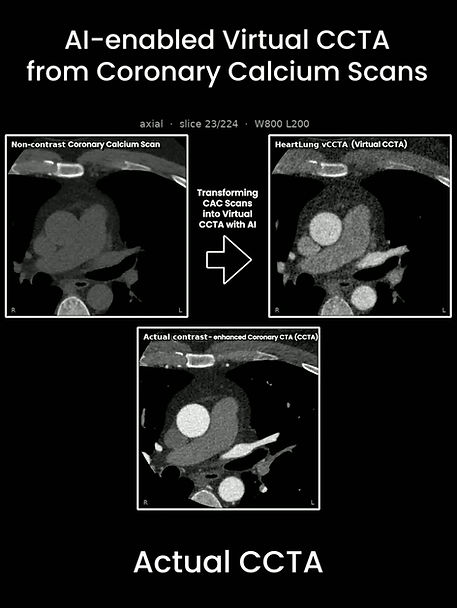
Agatston-2.0 is an AI-enabled approach to coronary artery calcium (CAC) CT that characterizes plaque distribution and density, aiming to add risk information beyond the conventional Agatston score. This Part III analysis examined whether the approach could further stratify adults whose conventional CAC scores were 1–99.
Study design
The pooled observational analysis included 1,542 participants from MESA (n=1,142) and the Framingham Heart Study (n=400) with CAC 1–99 below the standardized 75th percentile. AI-CAC features included a distribution index (number of plaques × vessels involved), a hyperdensity index, and relative-density measures. Coronary heart disease (CHD) events were assessed during follow-up.
Key findings
Over a median 12.5 years, 151 CHD events occurred. Ten-year cumulative CHD incidence varied across AI-CAC phenotypes: 2.2% for focal, dense calcium; 4.8% for focal calcium; 11.1% for diffuse, multivessel calcium; 14.8% for diffuse, low-density calcium; and 20.9% when the higher-risk phenotype was accompanied by an enlarged heart or aorta. Adding distribution and hyperdensity indices to the conventional score improved discrimination (C-index 0.562 to 0.625; optimism-corrected NRI 0.279).
Interpretation
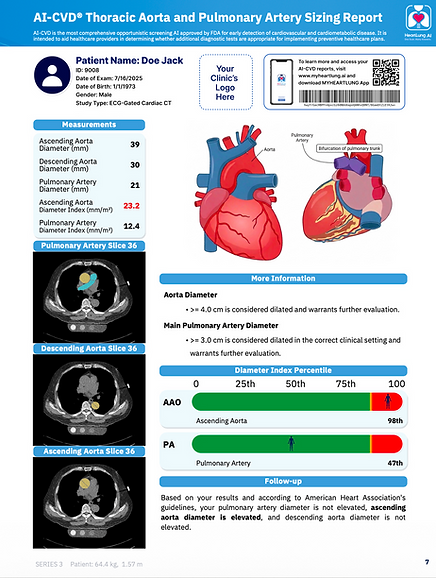
The findings suggest that AI-derived plaque patterns and density may distinguish substantially different risk profiles within the conventional CAC 1–99 group. As an observational cohort analysis, the study supports further validation and does not establish that AI-CAC-guided treatment improves outcomes.
Abstract
Background: Conventional CAC scoring has limited ability to distinguish risk among people with CAC scores below 100. Objective: To evaluate whether Agatston-2.0 AI-CAC improves CHD risk stratification beyond conventional CAC. Methods: Pooled MESA and Framingham cohort analysis of 1,542 adults with CAC 1–99 below the standardized 75th percentile; AI-CAC quantified plaque distribution and density. Results: Across 151 CHD events over median 12.5 years, 10-year CHD incidence ranged from 2.2% in a focal, dense phenotype to 20.9% with diffuse, multivessel calcium plus enlarged heart/aorta. Adding distribution and hyperdensity indices improved C-index from 0.562 to 0.625. Conclusions: AI-CAC phenotyping may identify lower- and higher-risk subgroups within CAC 1–99 and merits external validation.
Status: Submitted to the American Journal of Preventive Cardiology. Manuscript AJPC-D-26-01214. The full manuscript is not attached.


Comments