


AI-CVD Summary
Coronary Calcification

_4_edited.jpg)
Aortic Calcification

Epicardial Fat
_5_edited.jpg)
Cardiac Chambers
_7_edited.jpg)
Aorta & PA Size
_10_edited.jpg)
Lung LAI
_9_edited.jpg)
Lung HAI
_11_edited.jpg)
Liver Fat
_12_edited.jpg)
Muscle & Visceral Fat
_13_edited.jpg)
Bone Density

AI-CVD Bundle


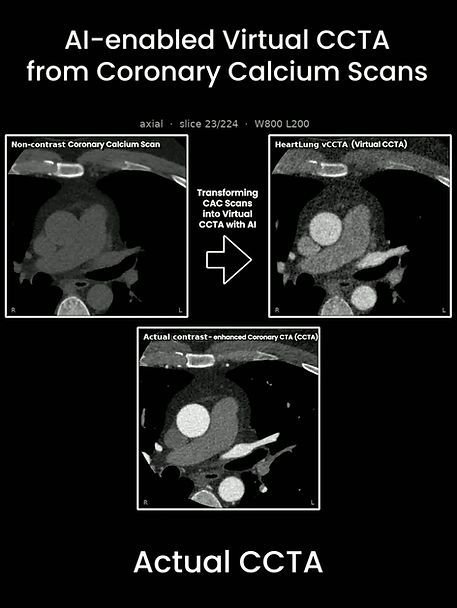
%20.png)




Research Summary
Artificial Intelligence-derived Measurements of Myosteatosis from Coronary Artery Calcium CT Scans to Predict COPD
Artificial Intelligence-derived Measurements of Myosteatosis from Coronary Artery Calcium CT Scans to Predict COPD: The Multi-Ethnic Study of Atherosclerosis
Purpose:
To evaluate the predictive value of myosteatosis as an opportunistic finding in coronary artery calcium (CAC) CT scans for clinically diagnosed chronic obstructive pulmonary disease (COPD) and compare it with an artificial intelligence (AI)–measured biomarker of emphysema derived from the same scans.
Materials and Methods:
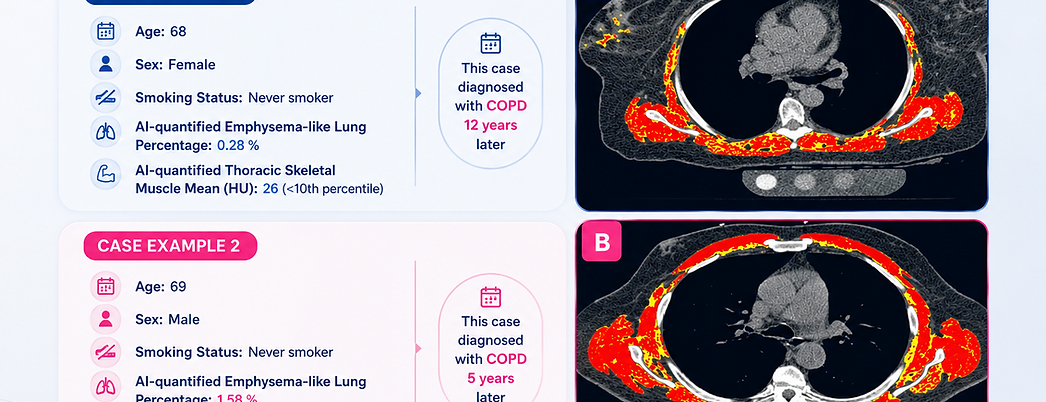
In this prospective study, baseline CAC CT scans and 20-year follow-up data were analyzed. Myosteatosis was defined as the lowest quartile of thoracic skeletal muscle mean attenuation (males < 33.5 HU, females < 27.0 HU). The emphysema-like lung biomarker was quantified as the percentage of lung voxels below −950 HU in CAC CT scans. COPD was identified using the International Classification of Diseases, Ninth Revision, Clinical Modification, and International Classification of Diseases, 10th Revision, Clinical Modification diagnostic codes from hospital discharge records. Hazard ratios (HRs) for COPD were calculated using proportional hazard regression models, comparing the bottom versus top quartiles of myosteatosis and emphysema-like lung measurements.
Results:
Among 5,535 participants in the Multi-Ethnic Study of Atherosclerosis (mean age ± SD, 62.2 years ± 10.3, 47.6% males), 396 (7.1%) were diagnosed with COPD over the 20-year follow-up period. Myosteatosis showed a stronger association with COPD than emphysema (unadjusted HRs, 5.98 [95% CI: 4.14, 8.63] and 2.12 [95% CI: 1.61, 2.78], respectively [P < .001]). After adjusting for covariates (age, sex, smoking status, body mass index, race, asthma, physical activity, inflammatory markers, and insulin resistance),
Figure Gallery

Authors

Ali Hashemi
Heart Disease Prevention Program, Mary and Steve Wen Cardiovascular Division, University of California Irvine School of Medicine, CA 92697, USA

Anthony Reeves PhD.
Heart Disease Prevention Program, Mary and Steve Wen Cardiovascular Division, University of California Irvine School of Medicine, CA 92697, USA
Amir Azimi MD.
Heart Disease Prevention Program, Mary and Steve Wen Cardiovascular Division, University of California Irvine School of Medicine, CA 92697, USA
Kyle Atlas
Heart Disease Prevention Program, Mary and Steve Wen Cardiovascular Division, University of California Irvine School of Medicine, CA 92697, USA
Jakob Wasserthal
Heart Disease Prevention Program, Mary and Steve Wen Cardiovascular Division, University of California Irvine School of Medicine, CA 92697, USA

Seyed Reza Mirjalili MD.
Heart Disease Prevention Program, Mary and Steve Wen Cardiovascular Division, University of California Irvine School of Medicine, CA 92697, USA
Chenyu Zhang
Heart Disease Prevention Program, Mary and Steve Wen Cardiovascular Division, University of California Irvine School of Medicine, CA 92697, USA
